
What to Look for in a Childcare Educator: 7 Qualities That Really Matter
When families visit a childcare centre, they often spend a lot of time looking at the building – the classrooms, the outdoor space, the kitchen, the security gates.
All of that matters.
But most parents who reflect on why they chose a particular centre say the same thing: it was the people.
The daily reality of childcare is not the facility. It is the educator who greets your child at the door every morning, who notices when something feels off, who remembers that your daughter loves dinosaurs and your son is still working on his confidence at lunchtime.
If you are visiting centres and trying to work out what separates a good educator from a truly great one, here are seven qualities worth looking for, and some questions you can ask to find them.
1. They Get Down to the Child's Level
Watch what happens when a child walks in.
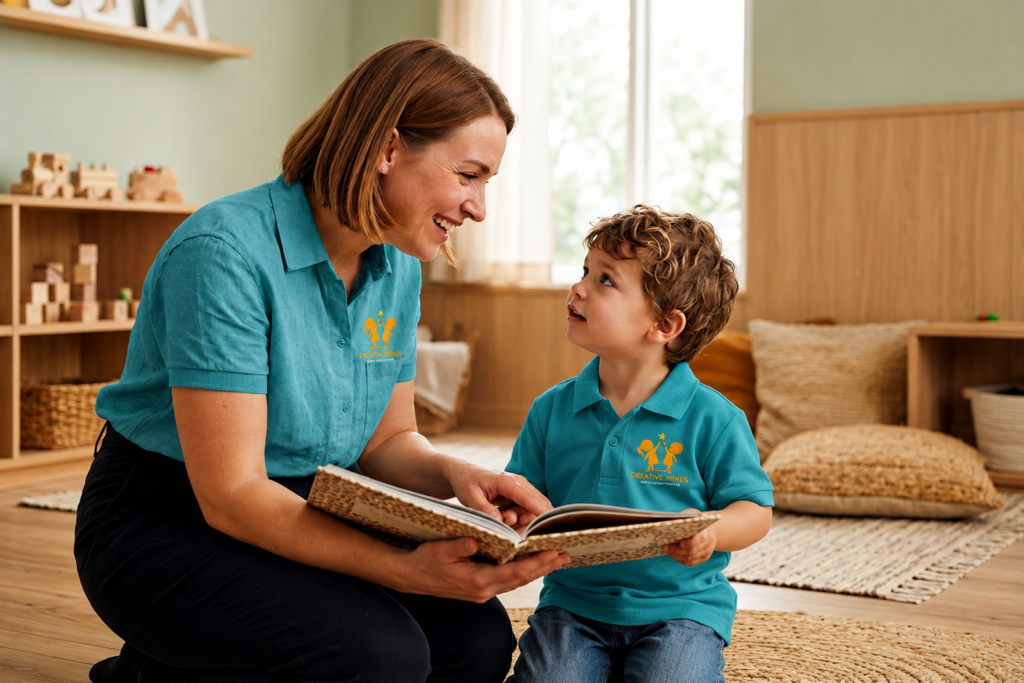
Does the educator crouch down, make eye contact and greet the child by name? Or do they speak from standing height, directing their attention mostly at the parent?
This small physical act tells you a great deal. Getting down to a child’s level is not just warm – it is developmentally intentional. It signals to the child that this space belongs to them, that their presence is noticed and that the adult in front of them is genuinely interested in them.
Young children communicate and connect differently to adults. An educator who instinctively adjusts to meet a child where they are, physically and emotionally, has learned to see the world from a child’s perspective. That perspective shapes everything about how they teach, comfort and support.
What to look for on your tour: When your child is in the room, notice whether educators speak to them directly.
2. They Know Each Child as an Individual
A quality educator does not manage a group of children. They know a group of individuals.
They know which child took three weeks to feel comfortable at morning drop-off and which one ran straight in from day one. They know who needs a quiet corner after lunch and who needs to move their body to reset. They know what each child is working on socially and emotionally.
This kind of knowing is only possible when educators have genuine relationships with children, and when they have been present long enough for those relationships to form.
Consistency matters here. High staff turnover makes deep knowledge of individual children almost impossible. When children have the same familiar faces day after day, month after month, they feel safe, and children who feel safe are children who learn.
What to ask: “How long have most of your educators been with the centre?” An honest answer tells you a great deal about the culture of the place.
3. They Are Qualified and Keep Learning
In Australia, all childcare educators are required to hold minimum qualifications under the National Quality Framework. But qualifications vary significantly between centres and between individual staff members.
Look for a centre where:
- All educators hold at least a Certificate III in Early Childhood Education and Care, with current First Aid, CPR and Blue Card
- Most educators hold a Diploma or higher
- At least one qualified Early Childhood Teacher (ECT) with a university degree is part of the team, this is particularly important for Kindergarten programs
- Staff engage in ongoing professional development, not just the minimum required
Qualifications matter because they reflect a foundation of knowledge about how children develop, learn and communicate. But equally important is an educator’s willingness to keep learning. The best early childhood educators are curious people, they read, they reflect, they update their practice and they genuinely think about what is working and what is not.
What to ask: “Can you tell me about the qualifications of the team in my child’s room?” A confident centre will answer this directly.
4. They Respond to Feelings Before Behaviour
One of the most telling things you can observe on a centre visit is how educators respond when something goes wrong.
When a child is upset, does the educator try to stop the behaviour or do they try to understand the feeling behind it?
When two children argue over a toy, does the educator intervene to take sides or do they sit with both children and help them find their own solution?
Skilled educators understand that behaviour is communication. A child who bites is not a bad child, they are a child who has not yet found the words for what they are feeling. A child who refuses to participate is not being difficult, they may be anxious, tired, overwhelmed or simply unsure.
Responding to the feeling first, acknowledging it, naming it, sitting with the child in it, builds emotional intelligence and trust. Children who feel understood are far more likely to develop self-regulation over time than children who are simply redirected or corrected.
This approach also reflects the Early Years Learning Framework (EYLF), which underpins quality early learning in Australia and places children’s emotional wellbeing at the centre of their development.
5. They Communicate With Families as Partners
The relationship between educators and families should feel like a genuine partnership.
A quality educator keeps parents informed in a way that is meaningful, not just administrative. That means sharing observations about your child’s development, not just reporting incidents. It means telling you that your child made a new friend today, or that they were absolutely fascinated by the worms they found in the garden, or that they seemed a little quiet this afternoon and might need an early night.
It also means being approachable when something is not working. Parents should feel comfortable raising concerns without worrying that it will affect how their child is treated. And educators should raise concerns with parents early and honestly, because a problem addressed at two weeks is far easier to resolve than one that has been building for six months.
What to look for: At pickup time, notice whether educators offer specific, personal updates or whether it’s a generic “they had a good day.”
6. They Support Independence Without Pushing
There is a balance that the best early childhood educators hold almost instinctively.
They want children to develop independence to pour their own water, pack away their toys, put on their own shoes, choose their own activity, solve their own small problems. They know that every time a child does something for themselves that they could not do last week, their confidence grows a little.
But they also know when to step in. They do not let a child struggle beyond the point where struggle becomes distress. They offer just enough help to keep the child moving forward without doing the thing for them.
This is called “scaffolding” in early childhood education, and it is a skill that takes years to develop well. Educators who scaffold effectively help children build real capabilities rather than dependence.
What to observe: Watch whether educators wait a beat before helping, giving children the chance to try first.
7. They Are Warm, Even on Hard Days
This last quality is perhaps the hardest to quantify, but parents almost always feel it immediately.
A warm educator is present. They notice. They remember. They bring genuine energy to their work even on a difficult day. They have chosen this profession not because it was convenient but because they genuinely love being with young children and watching them grow.
Warmth does not mean being endlessly cheerful or avoiding hard conversations. It means treating each child, and each family, as if they matter. Because they do.
Parents often describe it as the feeling they get at drop-off. Whether leaving their child feels like leaving them with someone who truly cares, or whether it feels like a transaction.
Trust that feeling. It is usually right.
What These Qualities Look Like in Practice
Lorem ipsum dolor sit amet,
When you put all seven of these qualities together, the picture looks something like this:
You arrive at drop-off and an educator greets your child by name, crouches down to their level and asks about the book they were reading at home last week because they remembered. Your child runs in without looking back.
During the day, your child works through a disagreement with a friend. The educator sits with both children, helps them find words for their feelings and guides them toward a solution they reached themselves.
At pickup, the educator tells you something specific, something small and real that happened during the day. Something that makes you feel like your child was truly seen.
These moments are not accidental. They happen in centres where educators are experienced, genuinely committed, and supported to build real relationships with the children in their care.
A Note on Staff Turnover
One of the most important, and least discussed, factors in childcare quality is how long educators stay.
High turnover is a warning sign. It often indicates poor working conditions, inadequate support or a culture that does not value its staff. And when educators leave frequently, children lose the consistent, trusting relationships that are foundational to their sense of security and wellbeing.
When you visit a centre, it is completely reasonable to ask:
- “How long have most of your team been here?”
- “Do you have educators who have been with you since you opened?”
- “What does the centre do to support and retain its staff?”
A centre that is proud of its team will answer these questions with genuine enthusiasm.
Questions to Ask on Your Next Centre Visit
Before you leave your tour, consider asking:
- “Can you tell me about the qualifications of the educators in my child’s room?”
- “How long have most of your team been with the centre?”
- “How do you keep families updated about their child’s development?”
- “What does a typical morning drop-off look like for a new child?”
- “How do educators support children who are finding the transition difficult?”
- “What does your professional development look like for educators?”
The answers, and how confidently and specifically they are given, will tell you a great deal.
At Creative Minds, It Starts With the Team
At Creative Minds Early Learning Centre in Pimpama, we believe the quality of your child’s experience begins and ends with the people in the room.
Some of our educators have been with us since we opened in 2017. Every member of our team holds a Certificate III or higher, with current First Aid, CPR and Blue Card, and our Kindergarten program is led by a qualified Early Childhood Teacher with a university degree.
Many of our educators are parents themselves. They understand — not just professionally, but personally — what it means to hand your child to someone else each morning. That lived understanding shapes how they care.
Parents often tell us their children do not want to come home. We think that is one of the nicest things a family can say.
👉 Meet our team at creativemindschildcare.com.au/our-team
👉 Book a free tour and see it for yourself
Or call us on (07) 5619 5930 – we would love to chat
Frequently Asked Questions
Under the National Quality Framework, all educators must hold at minimum a Certificate III in Early Childhood Education and Care. Most quality centres employ educators with a Diploma or higher, and Kindergarten programs must be led by a qualified Early Childhood Teacher with a university degree. All educators must also hold a current Blue Card, First Aid and CPR certification.
Watch how they interact. Do they get down to the child’s level? Do they respond to feelings before correcting behaviour? Do they speak to children directly and with genuine warmth? A quality educator is present, patient and clearly interested in each child as an individual.
Young children build security through consistent, trusting relationships with familiar adults. When educators change frequently, children lose those anchors and can take longer to settle and feel confident. A centre with low staff turnover is a strong indicator of a healthy, supportive workplace, and a better environment for children.
Ask about educator qualifications, how long staff have been at the centre, how they communicate with families and how they support children during the settling-in period. A quality centre will answer these questions confidently and specifically.
The EYLF is Australia’s national framework for early childhood education. It guides how educators support children’s learning, wellbeing, identity and belonging from birth to five years. Quality childcare centres use the EYLF as the foundation for their programs and individual learning plans.